Author: Sandeep Chaudhury

  • Project Invoice Proposal Approvals in Microsoft Dynamics AX 2012 R2

    Project Invoice Proposal Approvals in Microsoft Dynamics AX 2012 R2

    Hello Everyone,

    Here is a quick post on an update on the approval process of project invoice proposals in Microsoft Dynamics AX 2012 R2 release.

    In the AX 2012 feature pack release(Until Cumulative Update 4), the project invoice proposals were always forced or required to go through the workflow for approval.

    I came across many situations where customers did not want their invoice proposals to go through the workflow approval process as it is not required as per their business policies and rather have them posted directly. But in AX 2012 feature pack release, there was no way to have the invoice proposals not go through workflow approval.

    Microsoft has introduced a design change in AX 2012 R2 release, by which we can now have project invoice proposals not routed through the review and approval process in workflow.

    If you unmark the “Enable processing invoice proposals in workflow checkbox”, then you can directly post the invoice proposals without having it to go through the workflow process.

    image

    Pretty good and much needed change !!

    Regards

    Sandeep

  • Cumulative Update 1 for AX 2012 R2 is released

    Cumulative Update 1 for AX 2012 R2 is released

    Friends,

    A quick share from my side.

    The Cumulative Update 1 (CU1) for the AX 2012 R2 version has been released. Please refer to the link below for more details.

    Cumulative Update 1 for AX 2012 R2.

    Cheers,

    Sandeep

  • Managerial Hierarchy based workflow configuration for Timesheets does not work as expected when Timesheet is submitted by a Delegate in AX 2012

    Managerial Hierarchy based workflow configuration for Timesheets does not work as expected when Timesheet is submitted by a Delegate in AX 2012

    Friends,

    Hope everyone is doing well.

    Just wanted to share a quick information about an issue which you may face while implementing Timesheets approval of workers based on a Managerial Hierarchy.

    When you setup the Timesheet review workflow as “Hierarchy” based and setup appropriate reporting positions for the workers, you will notice that the timesheet when submitted “by a Delegate” for an employee, will get routed/assigned to the reporting manager of the delegate(who submits the timesheet), instead of getting assigned to the reporting manager of the actual employee.

    This is a known issue in AX 2012 feature pack(until the CU4 release) and you will need to make a code correction by taking help of your developers.

    However in the R2 release of AX 2012, this issue is taken care by the introduction of a small “Design change” in the workflow configuration. In the R2 release, you will be able to select “Worker” as the “Start from” location for the workflow. This will ensure that the timesheets even though submitted by a delegate, will get routed/assigned to the reporting manager of the timesheet worker/employee, but not to the reporting manager of the delegate. See screen below.

    image

    Please shoot questions in case you have any in this regard.

    Till next time !! Keep DAXING Smile

  • Time and Attendance Registration functionality of Microsoft Dynamics AX 2012

    Hello Everyone,

    I had been away from my blog since over a month time because of my work and long vacation. It feels nice again to write here and share knowledge with you all. We all thrive to learn new things always and so do I. Today, I decided to get my hands dirty on the new “Time and Attendance registration” functionality which is introduced in Microsoft Dynamics AX 2012 and share what I have learnt so far. Hope everyone finds this post useful.

    Dynamics AX 2012 has been amazing with its all new exciting range of features. I found the Time and Attendance registration feature pretty useful and decent and I am sure Microsoft will make it more powerful in the coming versions. Let me first explain you what this functionality is and how it can benefit organizations.

    Organizations of all sizes use Time and attendance systems to record when their employees start and stop work, and the department where the work is performed. It’s also a  common practice to track meals and breaks, the type of work performed, and the number of items produced. The Time and attendance functionality of AX 2012 enables organizations to track the time and attendance including the jobs on which the workers are working on a given day. Using this functionality the workers can register various types of times such as Clock in, Clock out, Absence, Breaks, Flex time, Overtime etc. This functionality will find a lot of traction in the manufacturing industries where lot of the workers are paid based on their working profiles and make time registrations.

    The below diagram depicts the overall flow of the worker’s time registration process in Dynamics AX 2012.

    image

    Now that we know an overview of the Time and attendance functionality, let us look at the setups which we need to make in order to use this functionality.

    Basic setup for T&A:

    There are a bunch of setups present under the Time and attendance form in the human resource module. Each of these setups as a significance and I will not explain those here as I will primarily highlight the process of the time and attendance recording in this post.

    image

    Calculation and Approval groups:

    • The calculation groups are a way to categorize the workers. For example, workers working in ‘same shifts’ or workers working in ‘same teams’. This helps the team lead/manager who calculates the time registrations for approval, to calculate the time registrations for a bunch of workers falling in same calculation group and this ensures reduced time in calculation.
    • Navigate to HR > Setup > Time & Attendance > Groups > Calculation groups and create a new record.
    • Optionally, you can password project the calculation groups by providing a password under the General tab.

    image

    • An approval group is logically same as the calculation group and typically consists of a set or group of workers.
    • Navigate to HR > Setup > Time & Attendance > Groups > Approval groups and create a new record.

    image

    Indirect activities and Absence codes:

    • Dynamics AX 2012 enables workers of an organization to register time on several indirect activities which they may work on a given day and it also allows to register hours on absence codes if they are absent from working hours. Few examples of indirect activities are “Meetings”, “Travel” etc. .(Activities which are not directly related to projects, jobs)
    • Four different types of time registrations are allowed for the indirect activities which are “Job”, “Break”, “Switch code” and “On call”. Indirect activities are ideally configured under an activity group.
    • Go to HRM > Setup > Time & Attendance > Indirect activities.
    • Create a new record and select the Registration type from the four option as per your requirement. In my example, I will select Job.

    image

    • Click Activities button.
    • Create new indirect activities such as Test1 and Test 2.
    • Check the Registration check box under General tab and specify account and offset account if needed.

    image

    • You can also setup cost for the indirect activities by clicking the Cost button. Refer to screen below.

    image

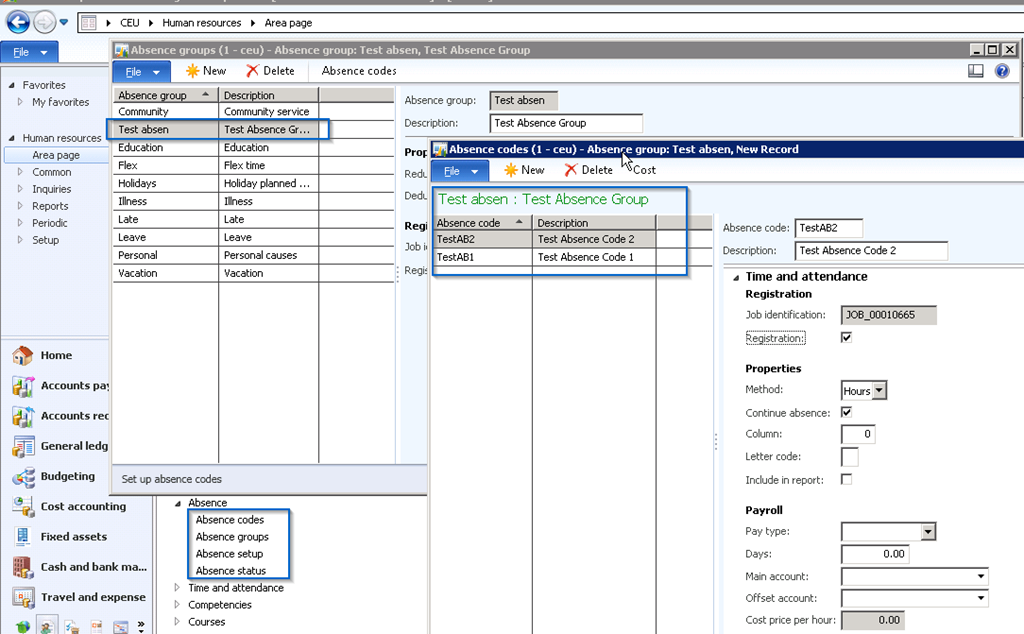
    • Similarly absence groups and codes can be configured for recording time for absence from work. If “Education break” is an example of absence group, then absence codes under it could be “ Training”, “Workshops”, “Long term education” etc.
    • Configure the absence groups and codes under HRM >  Setup > Absence > Absence groups.

    image

    Setup Worker/Employee for Time Registration:

    • Now that we have done most of the setups required for the Time and attendance function, let us setup the a worker and enable him for time registrations.
    • AX 2012 allows the workers to make time registrations in two forms. The Electronic timecard form and the Job registration form. In this case, we will just enable a worker to make registrations in Electronic time card form.
    • To do this, go to HR > Common forms > Workers > Workers.
    • Select any worker and double-click.
    • Click the Employment tab and expand the Time registration fast tab to set up parameters related to activating the worker for time registrations.

    image

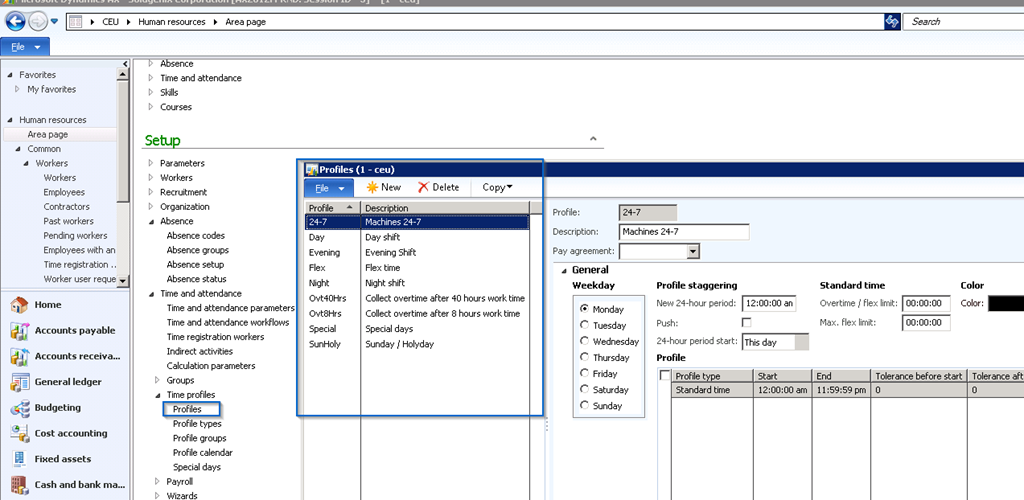
    Setup Work Time Profiles:

    • Different work time profiles can be configured for workers working in different working hours and tasks. The worker time profile basically identifies the nature of time registrations which the workers is supposed to make in a given day. For example a worker can clock in, work for standard working hours, take a break, work overtime and clock out. The work time profile basically will contain these profile types.
    • The work time profiles are configured and setup for group of workers usually. For example, workers working on Day shifts may be allocated with a  “day shift” profile and workers working in “evening shift may be allocated with a “evening shift” profile.
    • When the work time profiles are setup in the worker time registration, then the time and attendance system automatically detects the profile depending on the clock-in time of the employee. The work time profile functionality and concept is large and I will cover this in detail in one of my upcoming posts.

    image

    Time and Attendance Registration Process in AX 2012:

    • In this post of mine, I will cover only the time registration process using the Electronic time card functionality. I will try to discuss the Clock-In/Clock-Out time registration functionality in posts later.
    • As we have set up Ahmed to register electronic time cards, we will now see the steps which he will follow to make time registrations.
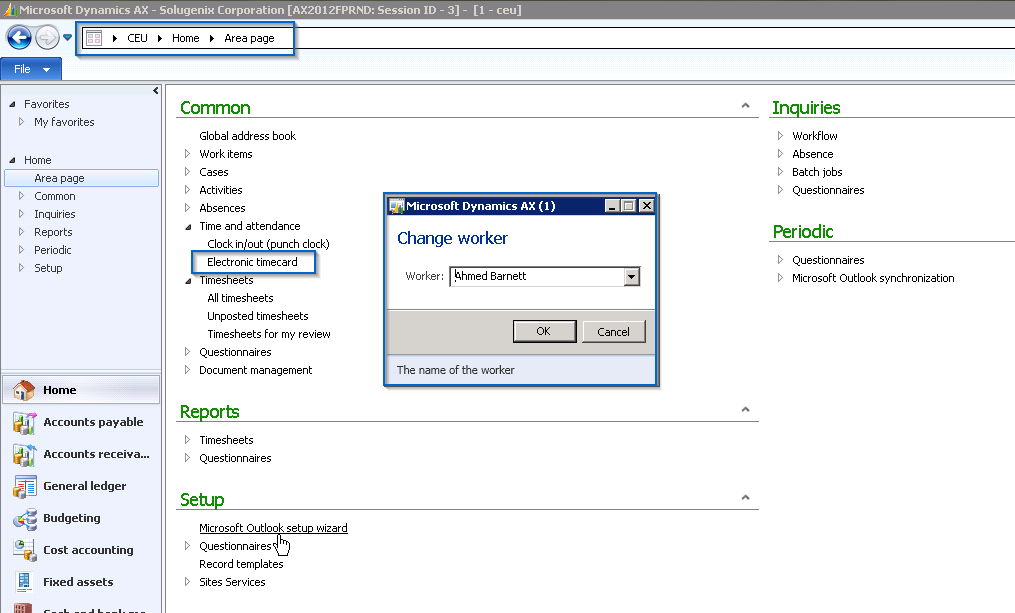
    • Go to Home > Time and Attendance > Electronic Timecard
    • Select the worker. (Ahmad in this case)

    image

    • System will automatically show the profile for the worker and the profile date will default to the current date/day. You can modify the profile date.
    • If you want your registrations not to be modified by team lead or your manager, then you can Lock the profile date by clicking the Lock button.
    • See the screen below in which I have entered a standard day’s time registrations.

    image

    • After filling in the time card, click Check button. System will validate that all your time registrations are fine and checked for any violations.
    • Finally, Click Transfer to, transfer the time registration for calculation and approval.

    Calculate and Approve Time & Attendance Registrations:

    • The next task is for the supervisors or the team members to calculate the time registrations done by their workers.
    • During the calculation, the worker time registrations are calculated against the work time profile. If there are any missing registrations, then it is automatically detected during the calculation and system will generate errors indicating these. The team lead or supervisor can then correct and recalculate the registrations.
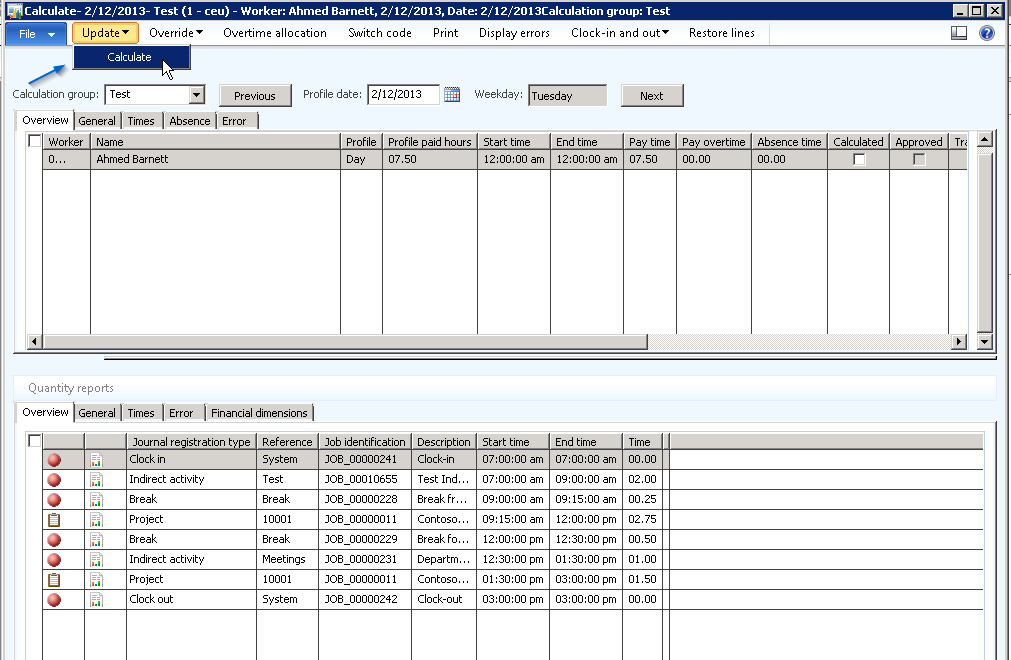
    • To do this go to HRM > Common > Time and Attendance > Calculate.

    image

    • Select the calculation group and date. The calculation group will enable the supervisor to mass calculate the time registrations for the workers here.
    • Click Ok button.
    • Note that, system may prompt for password if you have configured in the calculation group setup.
    • On the Calculate form, verify all the information and click Update > Calculate button and then click Ok on the

    image

    • After the time registrations are calculated and verified, it needs to be approved. Approval is ideally done by the HR manager/Payroll manager. This is to ensure that the time registrations looks all correct before they are committed and posted in other modules.
    • To approve the time registration, Go to HRM > Common > Time and Attendance > Approve.

    image

    • On the Approve form, click Update > Approve and then click Ok on the batch job.

    image

    • You will get a confirmation that the registration for approved without errors.
    • The next task for the payroll manager or whoever approves the time registrations is to transfer the time registrations. This will ensure that all the transactions are posted successfully to the jobs on which registrations were made.
    • To transfer the time registration click Update > Transfer and then click Ok button on the dialog.

    image

    • Notice that the TR lines will get transferred from the Approve screen.

    image

    • Not let us verify the postings in the different modules. For example in this time registration Ahmed had entered time on the project 10001. So if you go to project 10001 and then to Posted transactions, you will find the the transactions created by the TR system. See screen below.

    image

    In this post , I covered,

    • The overall set up required to use the time and attendance system in AX 2012.
    • How to enable workers to make time registrations.
    • The actual time registration process.
    • And the calculation, approval and transfer process for the time registrations. Consider these as the first step to learn this new functionality. I am breaking it down as this is getting way too longer now. Smile

    In my next post, I will cover the remaining part of this functionality.

    • More about the absence management.
    • Time and attendance workflow.
    • And the complete integration with pay agreements and payroll process.
    • Time registration using the Clock in/out punch clock
    • Which industries types can use and benefit from this ?

    Well ! That is it for now.

    Till next time…Keep exploring.

    Thanks

    Sandeep

  • “The Value FeeRet in the Category field is not valid according to the Category setup” Error in AX 2012

    “The Value FeeRet in the Category field is not valid according to the Category setup” Error in AX 2012

    Friends,

    I have been busy in work after my long vacation  and break from blogging.

    Today, I just wanted to write a quick post about troubleshooting an error which you might face while submitting invoice proposals which has retention enabled in it in Microsoft Dynamics AX 2012.

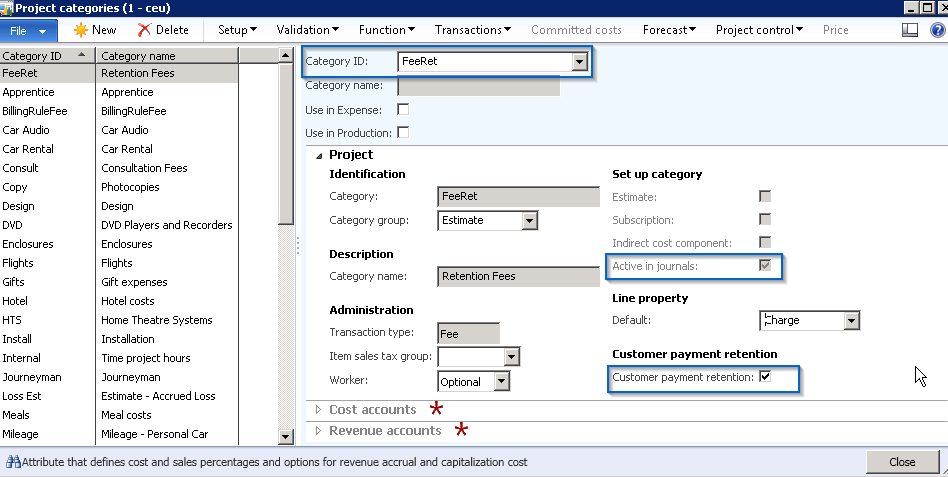
    If you come across the error with message“The value “ FeeRet“ in the Category field is not valid according to the Category setup” , where “FeeRet” is the customer payment retention category, then make sure that The “Active in journal” and “Customer payment retention” check boxes are marked in the Category setup under Project Management and Accounting > Setup > Categories > Project Categories.

    Refer to screenshot below.

    image

    Note : Please note that, if you select the ‘Customer payment retention’ check box prior to the ‘Active in journal’ check box, then you cannot mark the ‘Active in journal’ check box anymore, as it will be disabled.

    Hope this will help. Lot of new exciting posts coming soon. Stay tuned.

    Keep DAXING Smile

    Sandeep

  • Happy New Year 2013

    Happy New Year 2013

    Dear All,

    Tomorrow will be the first blank page of a new 365 page book. Write a good one !! Hope, all of us will have lots of Happiness and Success in the coming year.

    Wishing you and your family a very happy and prosperous New Year .

    Happy_New_Year_2013

    Regards

    Sandeep

  • Committed Costs in Project Management in Microsoft Dynamics AX 2012

    Committed Costs in Project Management in Microsoft Dynamics AX 2012

    Efficient cost management in Projects is always one of the key aspects to ensure that the project remains optimally profitable, especially in cases of fixed price contracts where revenue remains fixed. A clear visibility of all aspects of the cost data in the project helps the Project Budget Manager or Project Controller to ensure that the expenses in the project are well controlled and the project is adequately funded on time.

    The common practice followed widely by most of the Project organizations is to establish a project budget for the costs and then track the actual project costs(Realized costs) against it, to arrive at the remaining budget balances, % of work complete in the project etc., for the managers to take suitable actions on funding effectively.

    While the actual costs/realized costs gives the required visibility to the remaining budget balances of a project, there is one other cost component which should be considered. This is called the “Committed costs”.

    The “Committed costs” are the project expenses that are used over a period longer than the cost reporting period. An example of this is the materials and services(Subcontractors and Consultants) getting used in a project. Once a purchase order has been issued to a supplier or subcontractor, then the funds for that purchase order are “Committed” by the organization.

    In today’s post we will take a look the “Committed costs” functionality for Projects in AX 2012 and discuss how this could be helpful for service industries such as the Construction, advertising and media where the subcontracting services are usually used for a longer time period.

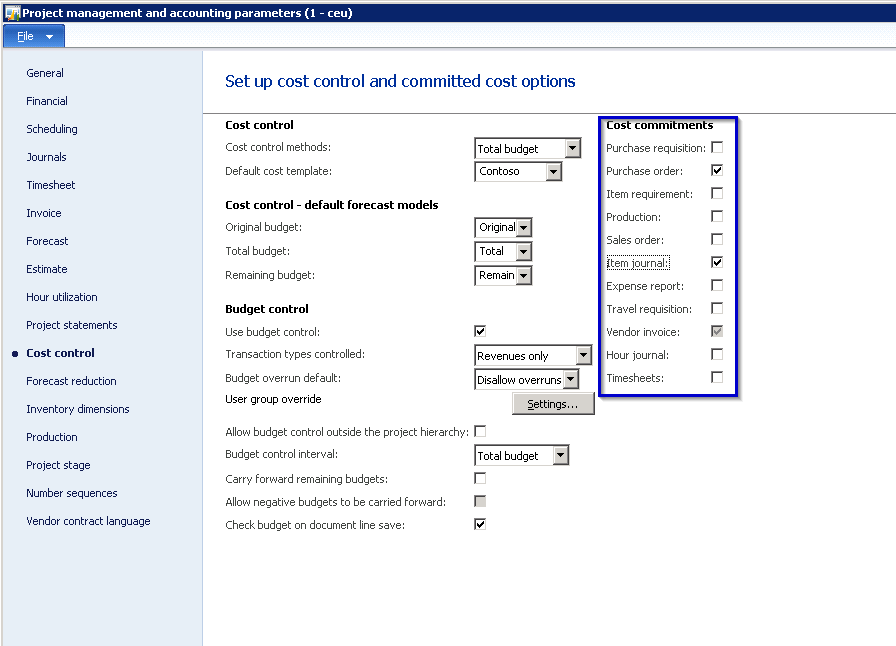
    The first thing to understand is the parameter setup under the project module. Notice that Dynamics AX 2012 makes it flexible and allows users to designate all the types of transactions which could form a cost component in a project, in stead of just limiting this to just Purchase orders and Vendor invoices. Users can select or deselect these transaction types to decide if they want those to be reflected as “committed costs” in the projects. Take a look at the screen below.

    image

    In this case, I will consider the purchase order, Item journals and vendor invoices as committed costs. I will also create a Fixed price project and then allocate budget to it and finally post some purchase orders, item journals and vendor invoices for this project to see how the “committed costs” work.

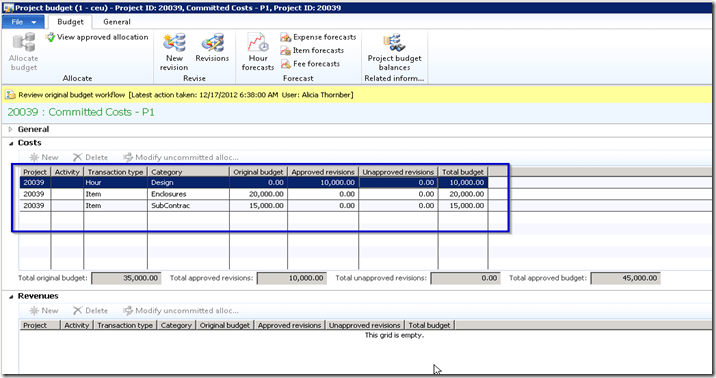
    Below screenshot shows the total budget which I have defined for this project for the items and the subcontracted labors.
    image

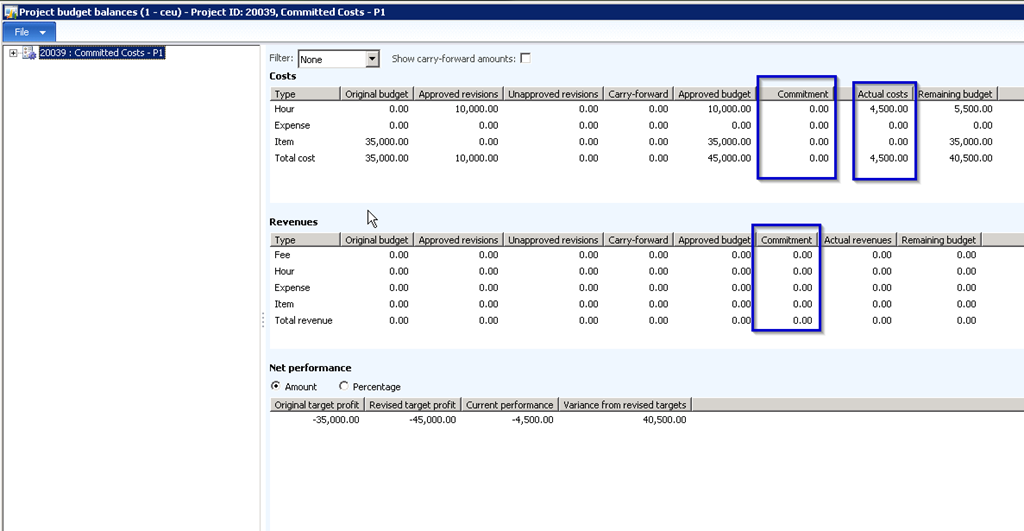
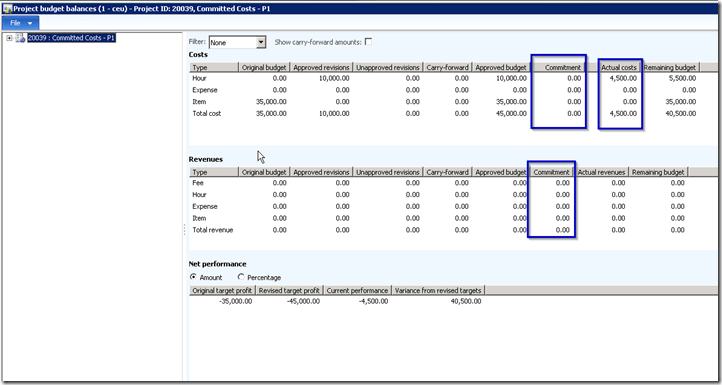
    We will now post some costs on this project by booking few hour journals to record some actual costs on the project. See the screenshot below which shows all the details in the Project budget balances screen. This shows that there are no commitment costs/committed costs.
    image

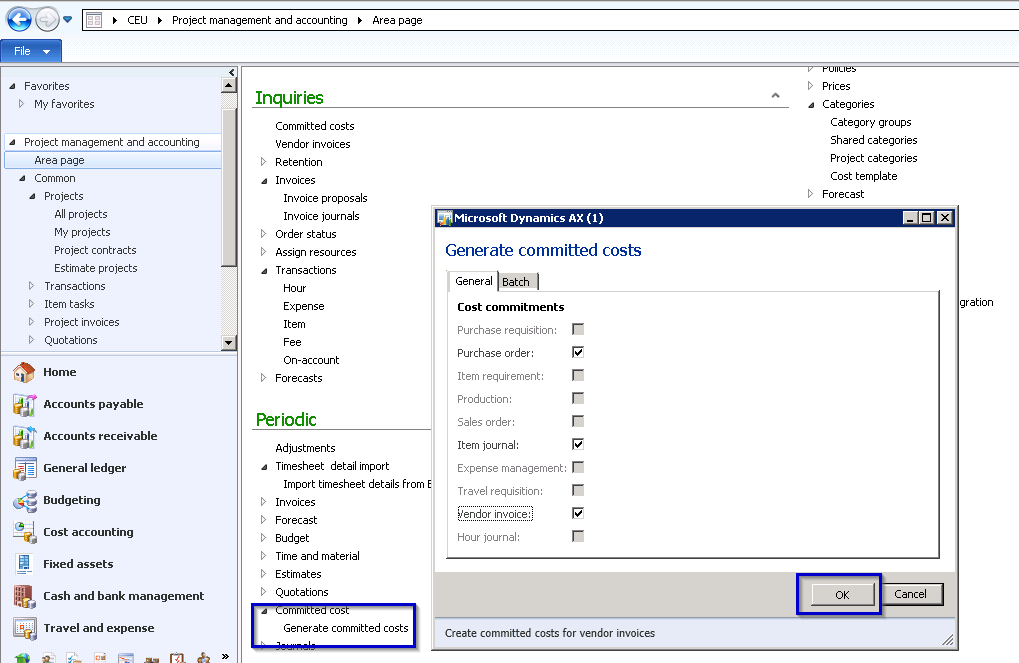
    Now let us create a purchase order(Do not post) and book a vendor invoice and see the impact on the committed costs. After creating the purchase order and vendor invoice for the project, navigate to Project Management and accounting > Periodic > Committed costs > Generate committed costs and click OK button. (Ideally this could be set to run in batch automatically).

    image

    Now let us enquire the project budget balances and see how system automatically shows these as committed cost so that project budget manager or project controller gets a better visibility of the costs for this project.

    image

    Also, you can navigate to Project > Control Tab > Costs > Committed costs button and system will show the details for all the committed costs on the project in this screen and users can click the Item tasks button to go to the source document which forms the basis of the committed cost and then take suitable actions.

    image

    Hope this post was helpful.

    Thanks

    Sandeep

  • Microsoft Dynamics AX 2012 Launched in India

    Microsoft Dynamics AX 2012 Launched in India

    The wait is finally over !!!

    Microsoft Dynamics AX 2012 is now launched in India. India has been one of the key emerging market segment for Microsoft Dynamics AX ERP over the years and the launch of Dynamics AX 2012 in India will definitely gain attention with its new improved and powerful purpose-built solutions for Manufacturing, Distribution, Retail, Public sector and Service Organizations. Stay tuned.

    Read more http://gadgets.ndtv.com/laptops/news/microsoft-launches-dynamics-ax-2012-in-india-300731

  • Automated Tasks in Workflows in Microsoft Dynamics AX 2012

    Automated Tasks in Workflows in Microsoft Dynamics AX 2012

    The workflow engine of Microsoft Dynamics AX ERP has been one of the very important and capable tool over the different versions. It helps users to automate and streamline several business processes in the organization across several departments. Now, with Microsoft Dynamics AX 2012, the workflow engine gets even more stronger with the introduction of additional capabilities such as,

    • Easy-to-use graphical workflow components which allows users to create new workflows with easy drag and drops.
    • Parallel activities enables multiple users to take action on an workflow item simultaneously.
    • Sub-workflows works seamlessly under the main workflow.
    • Automated tasks, which if used properly, can prove to be very useful and efficient.

    Microsoft Dynamics AX-Powerfully Simple

    Recently I got chance to learn the automated tasks in AX and in today’s post, I will explain how we can configure automated tasks in a workflow and how it can help business in real time.
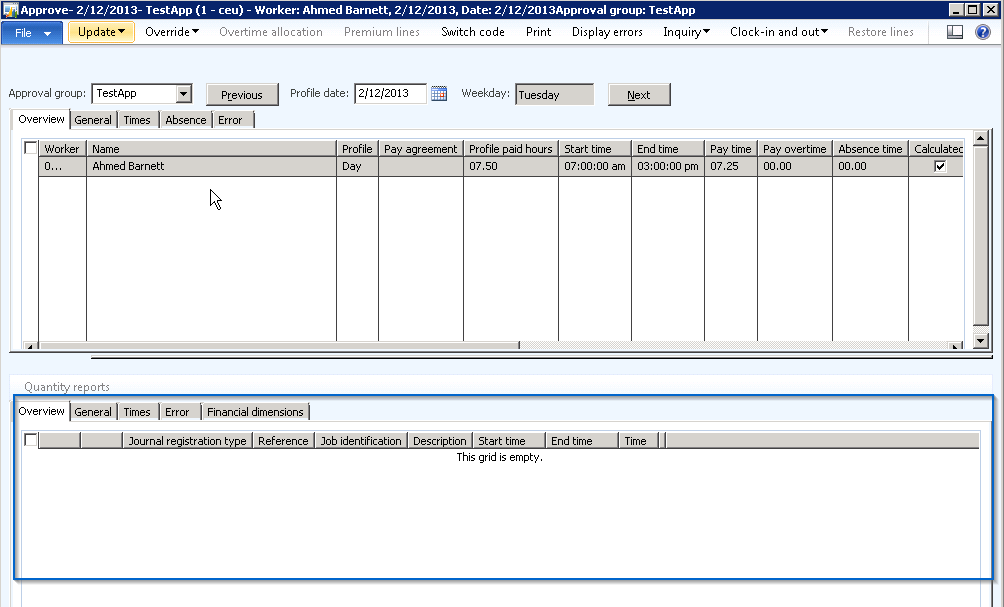
    Tasks such as posting transactions and generating reports or verifying results can run automatically or require an user intervention in Dynamics AX. In AX 2012, a workflow can contain both manual tasks(Requires user intervention) and automated tasks(Does not require user intervention).

    AX 2012 provides few automated tasks out of the box in some the workflows such as expense reports, budget entry workflow etc. However, you can create automated tasks as per your requirements, with a little help from your technical team.

    Let us assume a scenario, where we want to automate the “Credit limit check” for customers while approving Sales orders or Free text invoices, so that the automated task will complete the credit check and send the result to the workflow owner/user for them to take further actions.

    Below are the high level steps which you can follow to create a new automated task.

    1. Open AOT.
    2. Expand the Workflow node and go to Automated tasks node.
    3. Right click the automated tasks node and click New automated task.
    4. Now, right click the newly created automated task and go to properties.
    5. Set Name, Label , configuration keys.
    6. For the Document property, select the workflow document for which you need this automated task.
    7. In the Execution event handler property, select the event handler class which will actually run the Customer Credit Limit check. Here you can have your technical team’s help to create the Execution event handler class for you. Once you have the event handler class ready, select the same, in this property.
    8. And you are done.

    image

    For this demonstration in the post, I have not created the Event handler class for customer credit limit check. So, I will use an existing automated task (Automatic posting of expense reports) and demonstrate how it can be used in workflows.

    Follow the steps below to configure an automated task in a workflow.

    1. Go to Travel and Expense Management > Setup > Travel and Expense Management workflows.
    2. Create new Expense report workflow.
    3. Notice that the expense report workflow which comes out of the box, does not have the automated task, but you can configure it in the Workflow type.
    4. To do this, go the AOT > Workflow > Workflow Types and select the TrvDocumentTemplate.
    5. Expand the Supported elements node and drag and drop the automated task here.
    6. See the screen below where I have configured the automated task of Posting the expense report.

    image

    7.  Now, see the screen below which shows one very simple workflow which I have configured with the automated task is it.

    image

    8. When the workflow is run and it gets reviewed and approved, the workflow will be able to post the expense report automatically without requiring user intervention.

    9. Also, note that there will be no outcome after an automated task in run inside the workflow. The status will just changed to “Completed”. If you need outcomes for automated tasks, then you can write custom code with help from technical team.

    So, with few easy steps and custom code, Microsoft Dynamics AX 2012 makes it easy to automate lot of tasks in the business process which may not require an intervention.

    Hope this post will be helpful. Do not hesitate to contact  if you need help on this.

    Thanks

    Sandeep