Category: Dynamics 365

  • Collaboration workspaces in Microsoft dynamics AX 2012 for Projects, Campaigns and Opportunities

    Hi Friends,

    Dynamics AX 2012 has introduced a new functionality called Collaboration workspace across the projects, Campaigns and opportunities.

    Using this users can now share and collaborate all the related information together about projects, opportunities and Campaigns at one place inside AX without having the need to create and maintain separate sharepoint sites.

    This is simple yet powerful feature that can be widely used by users. In this post of mine i will demonstrate how to setup and create the collaboration workspace for projects in AX 2012. Please follow the steps below.

    Steps to setup Collaboration workspace in AX 2012:

    • Navigate to System Administration Module > Setup > Enterprise portal > Collaboration workspace settings.
    • Click New button.
    • Select One of the 4 business areas. If you want to create collaboration work space for all the areas(Projects, campaigns …) select All. In our case we will select Project.
    • Notice that after selecting the business area, the work space home page and template gets filled in automatically.
    • The template is the default template for the site layout and the user creates and links the collaboration workspace for a project. You can select one from the look up depending on your need.
    • There are other additional options for the user such as Creating the workspace automatically for selected project types, prompting for creation of work space for projects etc. These can be accomplished by marking the required check boxes.
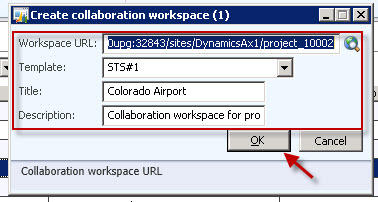
    • Now, navigate to Project management and accounting > All projects.
    • Select the project you want to create collaboration workspace for.
  • [Troubleshoot] -Timesheet Periods have not been created for: Employee – Error when creating Time sheets in Microsoft dynamics AX 2012

    Hi Friends,

    In one of my earlier posts, i gave a resolution for the error which users face normally when creating time sheets in AX 2009 PSA module.

    Just wanted to update the resolution for AX 2012 as the navigations are all changed in AX 2012.

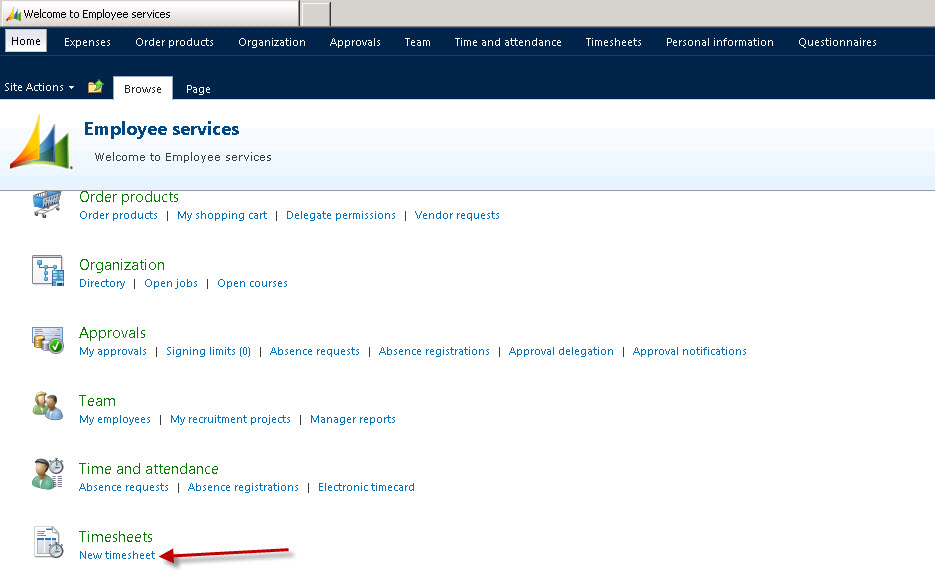
    As we all might be knowing that in AX 2012 users now will have to enter the timesheets in the Employee services portal(Enterprise portal).

    Launch the EP in AX 2012 and navigate to New timesheets( as shown in screen below ) .

    Click on the New Timesheet link. Now if you face an error as shown below then follow the steps mentioned below to fix it.

    Steps to Fix the above error:

    1. Navigate to Human Resources > Common > Workers > Workers.
    2. Select the employee/Worker which has this issue.
    3. Click Project Management tab.
    4. Click Setup > Project setup.
    5. Set a value for Period code ( For eg :EmplMonth). Refer to screenshot below.
    6. Save and close the form.
    7. Now to ensure that the timesheet periods are created for this period code, navigate to Project management and accounting > Setup >  Timesheets > Timesheet period types.
    8. Select the EmplMonth period code.

    Do let me know if you need further assistance on anything related to this post. ThanksKeep DAXING :)

  • Hands on AX 2012- All about budgeting functionality for projects in Microsoft dynamics AX 2012

    Hello friends,

    In this post of mine, I will explain all about the new budgeting functionality for projects in AX 2012.

    In AX 2009, we could do only forecasting of projects and then consider that as the project budget. There was not a well defined procedure for end to end budgeting of projects ( When i say end to end, it involves forecasting the project costs and revenues, creating budgets based on the forecasts, submitting the budget for approval, automatic budget overrun control, budget revisions etc).

    Now in AX 2012, MS has done a tremendous job in the project budgeting functionality and i must say, this can be used out of box for implementations without requiring any(Major) customizations.

    Let us now look at all the aspects of this one by one below.

    Let us assume that we have a fixed price project TEST_BUD_01.

    1. Setup the project budget parameters:

    • The budget control parameters can be set both at a global level and at the project level. To enable the budget control functionality for all the projects at a common place, go to Project Management  and Accounting > Setup > Project management and accounting parameters > Cost control link(On left pane).
    • Please see the screenshot below for the various fields for the budget control. Check mark the “Use budget control” check box
    • Set Transaction type to be controlled = Revenue and costs.
    • Budget overrun default = disallow overruns. Please refer to screenshot below.

    2. Create and submit the project budget:

    • Go to Project Management  and Accounting > Common > All Projects.
    • Select the project for which we will create the budget. (TEST_BUD_01).
    • Click on tab Plan and click Budget > Project budget. Please see the screenshot below.
    • Now on the Project budget form, select forecast models Original budget = OrigCash and Remaining budget = RemCash.
    • Now select a budget basis from the 3 options which are ,
      Entry – Enter the Cost and revenue budgets manually. Forecast – Select a forecast model and the project forecasts will be converted to budget. Project transactions – Select this if your want to budget your current project based on the transactions of any existing project.
    • Depending on the selection of the basis of the budget, the budget lines budget lines will be entered.
    • In our case we will create the project forecasts and select the budget basis as Forecast. Below screenshot shows the project budgets which are created from the forecasts when clicked on the Load Values button.
    • Click on the Submit button(Workflow Yellow bar) to submit the budget for required approval.
    • Run the workflow tutorial form to kick off the workflow and after the record is processed in workflow, come back to the project budgets form and approve it making yourself as the approver for TEST purpose.
    • Now notice the work flowinfolog which says the budget is committed to the project.

    4. Post project transactions:

    • I will not list out the steps to post the project transactions here as we all know about it. Let us say i will post 155  hours against category Design. With this let us verify the project budget balances.
    • Go to Project TEST_BUD_01 and click on Plan > Project budget.
    • Now on the Project budgets form, click Related information > Project budget balances.

    Please see the screen below which shows the actual costs incurred and the remaining balances in the project budget.

    6. Create and submit/Approve budget revisions:

    • The project budgets can be revised(+/-) as the project progresses depending on the project requirements.
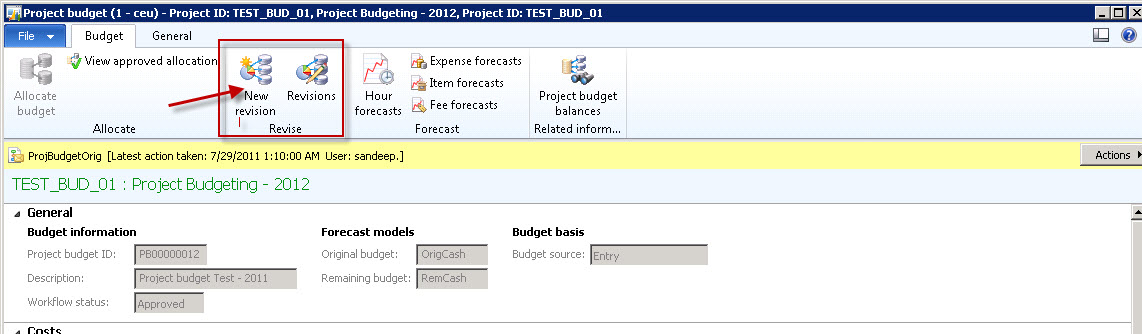
    • To revise the project budget, Go to the Project budgets form of the project and click on Revise > New Revision.
    • On the Project budget revision form, enter values in revision amount field. This Value can be +ve or -ve. If you want to increase the budget, give a +ve amount and the budget will be increased by that amount and you can see the updated value in New budget field. Provide a -ve value if you want to reduce the budget.
    • Enter the reviosn amounts as below.

    • Now after making necessary revisions, click Submit button to submit the budget for approval.
    • Once the revised budget is approved, the new values will be committed as the project budget.

    7. View revision history:

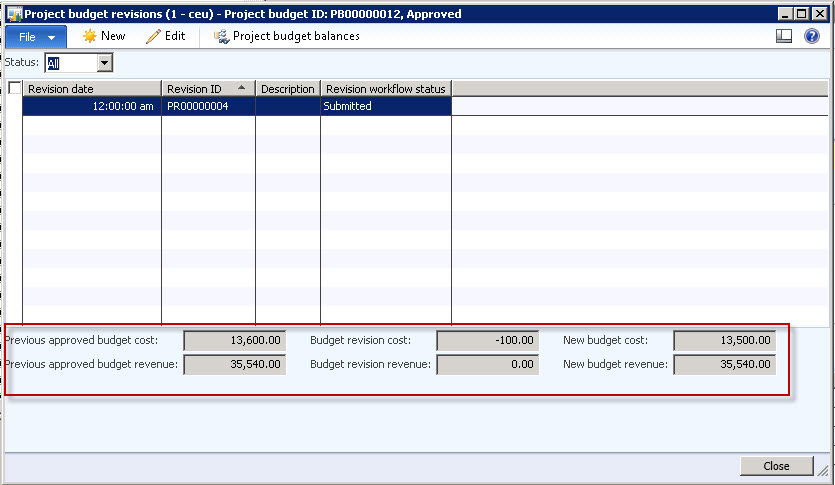
    • A complete history of all the budget revisions can be viewed at Revision > Revisions on the Project budget form.
    • Please see the screen below which depicts that he original budget and the revised amount and the new budget for both cost and revenues.

    Well, this is all about project budgets from my side. Let me know your questions and comments and i will be glad to answer you.

    Thanks

    Keep DAXING :)

  • What is new in AX 2012 : The Advanced funding functionality in project manngement accounting in dynamics AX 2012

    In AX 2009, we could invoice only one customer per project per contract. Now the funding for a project /project contract can be shared by any number of internal or external parties.

    User can configure a funding scheme which helps is setting up funding limits for one or more customers per category, category group or transaction type.

    In this post, i will walk you through the process of setting up the multiple funding sources for a project contract and we will also verify the impact of this when will generate the invoice for the projects. Also we will take Customer as the funding type while setting up the funding details.

    Note : Please note that the advanced/multiple funding can be setup among Grants/Organizations also.

    Please follow the steps below.

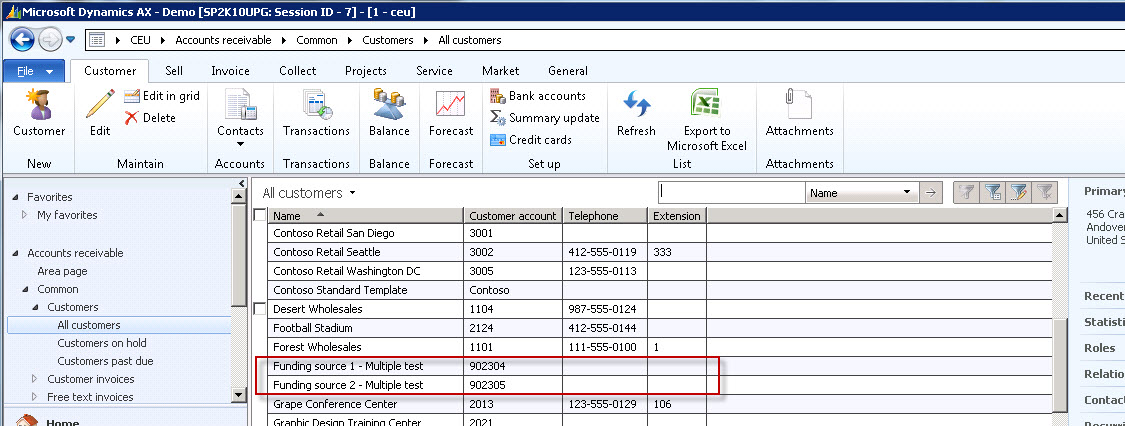
    • For better and clean understanding, let us create two new customers by navigating to Accounts Receivable > Common > All customers. Please see the 2 new customers whichi created for this demo purpose.
    • Go to Project Management Accounting > Project Contracts.
    • Click on the New > Project Contract on the actionpane and fill the required details  and click OK button to create the new project contract. Also create a new project and associate that to this project contract. Please see screen below.
    • Now , on the Project contract edit screen, expand the funding sources fast tab and see that there is one funding source which we attached while creating the contract.
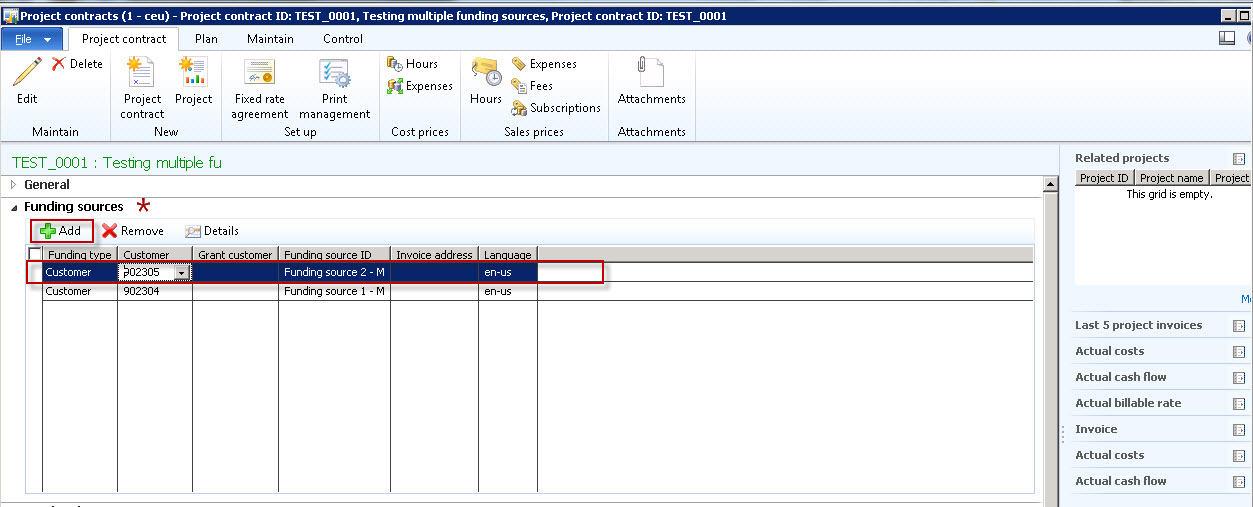
    • Click on the Add action pane button and add a new record with funding type = Customer, Customer = 902305(The second customer which we created). Please see screen below.
    • Now collapse the funding sources fast tab and expand the funding limits tab.
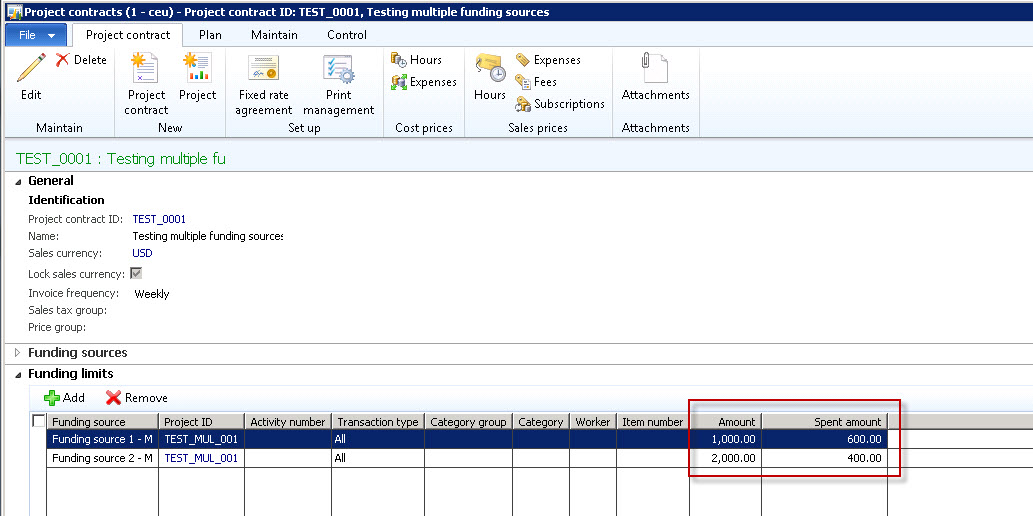
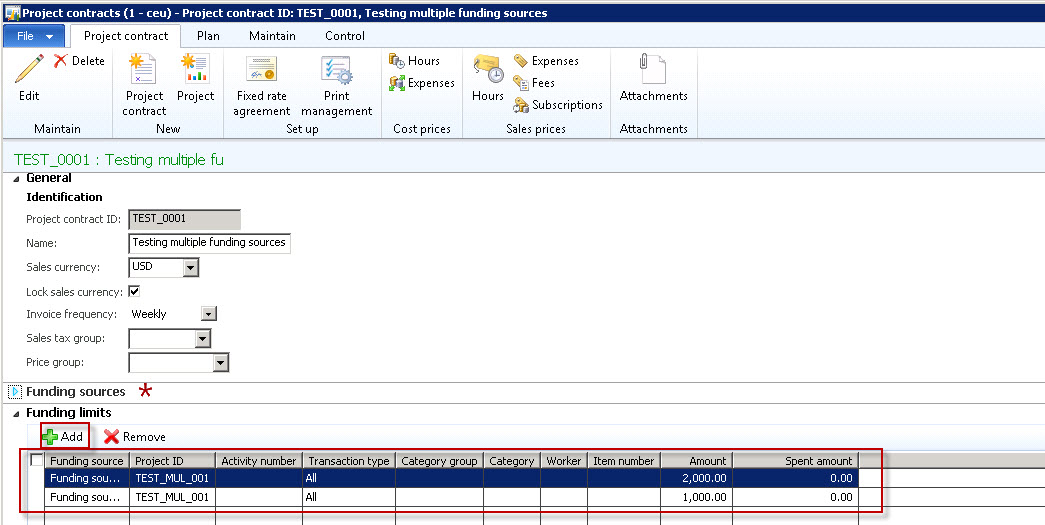
    • Create new line by clicking Add action pane button. Please see screen below for the demo purpose. Please note that these funding limit criteria can be made more specific my selecting different transaction types, category groups/categories etc but for this demo purpose we will go with a generic funding limit setup as shown below.

    • Click on New > Invoice proposals action pane button on the Invoice proposals screen and the click OK button on the next dialog by selecting the fields marked in screen below.

  • What is new in AX 2012 : The beginning balances for projects in microsoft dynamics AX 2012

    Hi Friends,

    In one of my earlier posts, i explained all the new exciting features that are added in the project management and accounting module in Microsoft dynamics AX 2012.

    Here, in this post I will explain one of the features which is the project beginning balances.

    This new feature will help organizations in transferring projects to Microsoft dynamics AX 2012 from legacy project management systems without affecting the general ledger.

    For e.g. , if you have been tracking a project in an outside application but managing costs and revenue in AX , you can transfer the project to AX , specify a beginning balance and then track all information at once place only.

    Let us learn how to  create and post a beginning balance on a project. Below are the steps.

    • The creation and posting of beginning balance transaction is allowed even when the project is in the Created state.
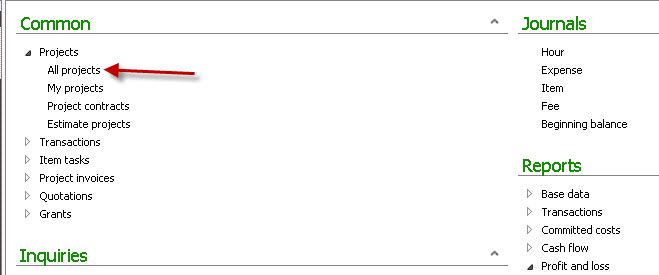
    • Navigate to Project management and Accounting > Common > Projects > All Projects.

    • Click on the New > Projects on the action pane to create the new project.
    • Click Setup > beginning balances menu button on the action pane.
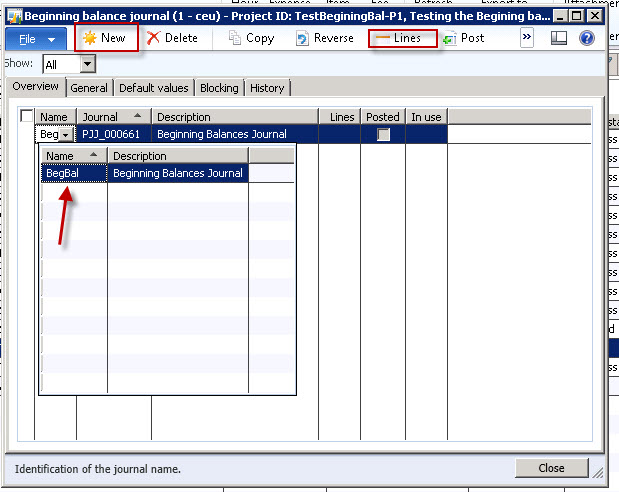
    • Click New button the action pane.
    • Select Begbal as the journal name for the newly created record.
    • Click on Lines action pane button.
    • Create the beginning balance journal lines which can be either Hour/Expense/Item/On Account and Fee type.
    • Click the Post button on the action pane. This will post the beginning balances for the project.

    Now verify that this posting of the beginning balance has affected the project statements where as the ledger remains unaffected.

    Please let me know if you have any questions on this and i will be glad to answer further. ThanksSandeepKeep DAXING :)

  • Statement currency conversion and consolidation in microsoft dynamics AX

    Hi Friends,

    Hope all is well your way. It’s been almost a month i could not write here as i went busy with work. Now here is one which i recently worked on for a customer.

    In the subsequent paragraphs i will explain how to perform the currency conversion for a subsidiary company operating on a foreign currency and also we will explore how to perform consolidation of this company with the parent company transactions.

    Scenario: let us assume that the subsidiary company is SUB which operates in GBP (Britain Pounds) currency and the parent company PAR reports in USD(US Dollar) currency. We will perform currency conversion followed by consolidation for the subsidiary company.

    The first task we have for this requirement is to perform the currency conversion for SUB company so that we can perform the consolidation then.

    Steps for the currency conversion:

    1. Navigate to Administration > Company accounts form and create a new company account and name it as CUR , Consolidation I – Currency conversion.
    2. Select the company account.
    3. Navigate to GL > Setup > Exchange rates form.
    4. Create a new currency called USD(main currency of parent company) and give 100.00 as exchange rate for this with a blank date.
    5. Navigate to GL > Setup > Parameters form and Mark the Consolidated company account check box.
    6. Come back to the Exchange rates form and create the currency of the subsidiary company which is GBP is this case.
    7. In the exchange rates grid below , setup all the historical exchange rates.
    8. Click on the consolidate tab and setup the closing and average rate.
    9. Navigate to Basic > Setup > Company information and give suitable company information and setup the primary currency as USD under the Other tab.
    10. Create the chart of accounts in the consolidated company. For the currency conversion task , you may prefer to choose identical COA as of the subsidiary company and then set the consolidation conversion principle for each of the accounts. Select between Historical, Average and Closing.
    11. Select the Subsidiary company and go to chart of accounts form. For each of the accounts, setup the mapping for the chart of accounts for the consolidation company CUR.
    12. Now , navigate back to the CUR company and go to GL > Periodic > Consolidation > Consolidation Online.
    13. Select an account range if needed if not leave it blank, select the period for which you want to convert the transactions into USD, Mark the Consolidation account, Current check box.
    14. Click the Companies tab and Select SUB from the look-up. Give Share = 100 %.
    15. Click Ok button.
    16. This will convert all the transactions into USD and you can enquire the same at Inquiries > Consolidation.

    Note : The setup for historical, average and closing rates are required as usually Income statement accounts will be converted on month average, balance sheet (non-equity) accounts on month closing and balance sheet (equity) accounts will be converted on historical rates under the US GAAP.

    Steps for the Actual consolidation:

    1. Create a new company account called CON.
    2. Do the similar setup as done above. Note that the GBP setup is not needed here as we will just consolidate the transactions.
    3. Do the COA setup for this and map these accounts both is PAR and CUR companies by specifying these in the Consolidation account field.
    4. Run consolidation from Periodic > Consolidation Online and specify both companies PAR and CUR under companies tab.
    5. Go to consolidation inquiries and verify that the transactions are consolidated.

    Assumption:

    The scenario described above is just one of the cases for consolidation when the subsidiary company is in a foreign currency. The COA setup, exchange rate setup and account mapping will differ from customer to customer. The best decision is to be taken as per that.

    Questions on this are most welcome.

    Thanks, keep DAXING. :)

  • The “Pay when paid” functionality in Microsoft dynamics AX 2009 PSA

    Friends,

    I will explain the pay when paid functionality available in Microsoft dynamics AX 2009 PSA module in this post. As the name implies , payment to vendors is made only when payment is received from customers and this process is automated in PSA.

    This functionality of PSA gains more attention in the AEC and advertising industry as huge amount of money is paid to sub contractors / vendors with very low contract margin. The implementation of the this functionality not only ensures a positive cash flow in the organization but also verifies that the customers/clients are also satisfied with the performance of the vendors.

    In order to ensure that the pay when paid works as intended, make sure the below setups.

    • Ensure the PSA parameters are setup properly. This includes the flags for pay when paid section.
    • Ensure that the pay when paid check boxes are marked properly in vendor group and vendor level.
    • Ensure the flags for pay when paid are setup correctly in Project contract and project.
    • The flags at the PO header and line level will inherit from vendor master.
    • Check the PwP flag at the AP voucher record.

    How the Pay when paid works – Information flow in pay when paid functionality:

    The pay when paid works using the logic depicted below.

    1. PwP looks at the threshold amount or percentage which are setup in the PSA parameters. If the amount is set up , system subtracts this value from the total customer invoice amount and the calculated difference is compared to the customer payments till date.If the total payments till date is greater than the difference , the customer invoice is said to be “Fully” paid.
    2. If the threshold percentage is set up , then percent value is subtracted from 100 and the difference is multiplied with the total customer invoice. If customer payments till date exceeds this value, then customer invoice is assumed to be fully paid.
    3. The addition of two new fields, “Customer payment status” and “Customer invoice number” in vendor transactions form forms a relationship between the Vendor invoice and the Customer payment.
    4. When a new AP voucher is initiated for the vendor payment/invoice, the value for the customer payment status will be Blank and customer invoice number will be null in the related vendor transaction record.
    5. Once the customer/client invoice is processed, the invoice number for this  will be updated for the related vendor transaction.
    6. Once a full payment is received from customer , the customer transaction will be updated as settled and system will cause the “Customer payment status” field to be set to Paid and if a partial payment is received , it is updated to Partial.
    7. When the vendor payment is initiated by using payment proposal option , then only those vendor transactions are filtered where customer payment status is Paid.
    8. When the vendor payment is initiated through manual settlement (Functions > Settlement option), then only those vendor open transaction which pass the PwP criteria are listed to be chosen for payment.

    Let us understand the example below to get a better idea on the pay when paid functionality of PSA.

    Let’s say your company sells speakers and you enter into an agreement with your customer to provide 200 speakers for them . As you dont have the manufacturing facility for the speakers, you engage a vendor/sub contractor to manufacture those for you. Let us assume that the price that the customer agreed on for each speaker is $100.

    Your customer also makes an agreement like they will approve the quality of the speakers before the they pay you . Therefore, your organization can have an option of not paying the third-party vendor until you have been paid by the customer.

    Now you can set up the project with a PWP threshold  percentage of 100%. This means that you will withhold all payments to the vendor until you receive full payment for the customer invoice.

    When vendor sends the speakers , say they charge $60 for each speaker, so along with the goods they will send an invoice of amount 200*60 = $12000. But you will not pay now them as you have the PWP setup.

    When you send the speakers to the customer, you will send the customer an invoice of 200*100 = $20000. The customer will inspect all the speakers and then if approves the quality of the product , they will pay the amount for your invoice.

    After you receive the full payment from the customer, you will pay $12,000 to the vendor for the full amount of their vendor invoice. This will ensure satisfactory service from the third party vendors.

    Hope this post will help understanding the base concept of PwP and  troubleshooting issues if any. Will be glad to answer more on this.

    Thanks, Keep DAXING :)
  • [Troubleshoot] -Timesheet Periods have not been created for: 2000 – Error when creating Time sheets in microsoft dynamics AX 2009 PSA

    Friends.

    Below is a very common error which users always wonder about when trying to create and submit their time sheets in Microsoft dynamics AX 2009 PSA module.

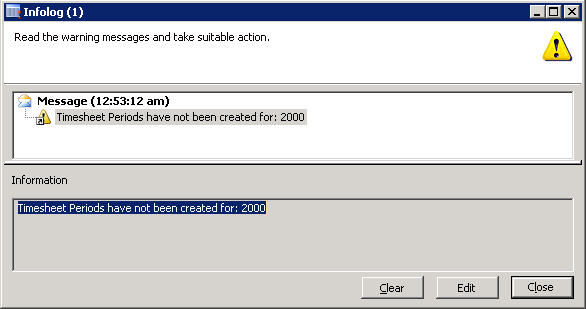
    Timesheet Periods have not been created for: 2000” , where 2000 is the logged in employee. The warning message is as shown below.

    Issue : This error comes when there are no time sheet periods defined for the employee.

    Solution : Follow the below steps to resolve this issue and be able to enter time sheets.

    1. Navigate to Basic > Employee details form.
    2. Select the employee record for which the error is thrown. ( Employee 2000 in this case).
    3. Click the Setup tab.
    4. Verify that a Period code is set up for this employee. If this is not setup already , you have to set a period code by selecting one from the look up.
    5. Then right-click on the period code , and click Go to the main form.
    6. Then, click the Update employee periods button.
    7. Give a suitable start and end date ( say 01/01/2011..06/30/2011) and click OK button.
    8. Click the Update time sheet periods button.
    9. Give a suitable start and end date ( say 01/01/2011..06/30/2011) and click OK button.
    10. Finally click the Show time sheet periods button and verify that there are records created for the time sheet periods for the period code attached to the Employee.

    This will fix the error above and the user will be able to enter time sheets then.I will be happy to recommend solution any other issues in PSA related to time sheets.

    Thanks, Keep DAXING :)
  • New and Changed features of Project accounting module in Microsoft dynamics AX 2012

    Friends,

    We have been hearing a lot about AX 21012 since last couple of months and i just got a chance to get into few details of the functionality which are added , changed and deprecated under the Project management accounting module of AX 2012.

    It promises to be giving us most if not all. Yes! Microsoft Dynamics AX 2012 is here with a very new face. In this post i will just put in the various features which have been added , removed and changed in AX 2012 and we will of course get into details of them when we have the product in hand.

    New Features in dynamics AX 2012 under Project management accounting module: What is New ?

    First and the most basic change is the module name itself. It is now called Project Management Accounting. Below are the list of new changes and add-on functionalities.

    1. Project budgeting:

    • Project budgeting is now possible at activity level.
    • Original budget can be created to define a budget at various level in the project hierarchy and it can be submitted for approval. It can also be allocated over a period of time.
    • Project budget revisions can be created at various levels of the project and they can be submitted for review and approval. These can also be allocated over a period of time.
    • When budget revision is approved , it causes and immediate change to the over all project budget.
    • A complete history or audit trial of the proposed, original, accepted(approved) and rejected budget is available for review at any point of time.
    • The project financial inquiry and the project financial status reports now presents a details of the project budget also.
    • If you are working on a multi-year project , you can carry forward project budget at the end of the year to the future year and make necessary change to the general ledger accounts associated with them

    Well , now this is complete budgeting. Seems like massive enhancements in project budgeting has been done by MS.:)

    2. Processing of item charges/costs in PO,SO and invoice lines:

    • Item charges/costs in the PO,SO and invoice lines are now recognized in projects.
    • Any taxes for the item charges will now be going to an expense account.
    • Item charges will now be recorded in project budgets and commitments.

    3. Project time sheets:

    • Over all UI experience will now be more user-friendly.
    • The way the time sheet comments and start and end dates are used are now much better.
    • Most importantly , user can now create and manage favorites in Enter Portal to be able to create time sheets in  a much quicker fashion.

    4. Advanced funding:

    • Well, this seems interesting. Customers have been looking for this one. In AX 2009, we could invoice only one customer per project per contract. Now the funding for a project /project contract can be shared by any number of internal or external parties.
    • User can configure a funding scheme which helps is setting up funding limits for one or more customers per category, category group or transaction type.

    This enhancement will definitely gain attention.

    5.Collaboration workspace:

    Even though not a widely used feature , if used properly, it can prove to be very beneficial.

    • You can create and add collaboration workspace in projects , campaigns and opportunities where project team members can quickly organize and share information within AX.
    • MS dynamics options can be setup and default the collaboration work spaces for users.

    6.Create and manage projects in EP:

    • Unlike AX 2009 , where only time and expense entries were possible in EP for projects , project managers can now create and manage their projects in EP itself.
    • Workers can enter daily working hours in a much improved manner and project managers can approve it on EP.

    7.Beginning balances:

    • This is another good feature. Users can now enter a beginning balance for a project which will help in transferring projects to Microsoft dynamics AX 2012 from legacy project management systems without affecting the general ledger.
    • For e.g. , if you have been tracking a project in an outside application but managing costs and revenue in AX , you can transfer the project to AX , specify a beginning balance and then track all information at once place only.

    8. Track project revenue from Free text invoice :

    • Ax 2012 now makes it possible for tracking revenues which are billed though free text invoicing. Cool it is !

    9. Transaction adjustments:

    One more !!This feature will make correction of wrong project entries easier which will allow adjustments even after invoicing.

    • Invoiced and estimated transactions can now be adjusted.
    • Adjustment dates can be used as project dates for adjustment transactions. Earlier it used to be the transaction date only.
    • The relationship between the original , reversed and the replacing transaction can be well traced now with information of what exactly the user adjusted.

    10. Progress billing , estimates and revenue recognition:

    • When migrating from one ERP system to another , the data migration is a big pain issue . Bringing in the existing data into the new system is most important where we face hurdles. This is to ensure that the revenue can continue to be recognized for the fixed price projects that are already underway.
    • Since revenue recognition depends on the completion % of the project , the data must be migrated so that both % of work completed(actual cost) and the remaining work(cost to complete) are reflected in proper accounts.
    • So the introduction of features such as beginning balance , progress billing and revenue recognition provide adequate support to these issues.

    Well , apart from these bunch of significant functionality, AX 2012 also promises to give a significantly improved UI experience across the modules with the introduction of new form controls such as , action panes , Fact boxes , Fast tabs etc.

    Fast tabs : The legacy tabs on the AX 2009 forms are getting replaced by fast tabs which the user can expand ans collapse to view and edit information.

    Fact boxes : Every module will now have fact boxes in all the important forms such as Customers, vendors , Items , Projects etc. These fact boxes will display 5-10 facts about each of the entities. For example , in the Project details form we will have fact boxes that will show related information. Please refer to the screenshot below for few fact boxes in Project quotations form in AX 2012.

    There are 3 Out of box fact boxes present in the project quotations form in AX 2012 as seen above. They are, Latest sales orders, Latest sales quotations and the Related information. These fact boxes displays important data related to the selected quotation record in the form. So user can have access to these critical data without having to navigate to the related forms.

    With these , the user can have access to critical project data staying in a single form without having to navigate to related forms and calculating values. Moreover , user can also customize the information in the fact boxes. Is it not interesting !

    We will realize all of these soon in the application.

    Hope you all will find this information helpful.

    Thanks, Keep DAXING :)

  • Integration of microsoft project server 2010 with Microsoft dynamics AX 2012 : What’s new , Benefits and Improvements

    Friends,

    Today’s post will talk about the functionality of integration of Microsoft project server 2010 with Microsoft dynamics AX 2012. We will just discuss all the new features that have been introduced in AX 2012 as we all must be knowing about the standard integration between these two application has been a functionality from AX 2009.

    Benefit of integration between Microsoft dynamics AX 2012 and Microsoft project server 2010 :

    • Project manager can create projects and other related data in either of the products(AX or project server) and then can synchronize data between them.
    • This will help in getting both the core project management capabilities of project server and the financial management services of dynamics AX 2012.

    New features of integration between AX 2012 and Project server 2010:

    Well , apart from the existing integration features between the two applications , the following are added newly in the AX 2012 version of AX.

    1. Now, the project hierarchies created in project server 2010 can be synchronized with Microsoft dynamics AX 2012.
    2. Also, the resource assignments in project server 2010 can be synchronized with Microsoft dynamics AX 2012.
    3. When the integration between these two is enabled , the activity breakdown structure can be maintained in the project server only and it will be read only in AX 2012.
    4. Now , any customized fields in AX 2012 by ISV can be synchronized with project server 2010 by defining the mapping in SyncIntegratedFields table in AX 2012.

    Entities that can be integrated:

    The following elements in the Microsoft dynamics AX 2012 can be integrated with project server now.

    • Workers (The integrated resource pool in project server).
    • Projects
    • WBS (The activities which are of type Task)

    How do I troubleshoot integration errors:

    It is common that users encounter errors when trying to integrate the project server with Dynamics AX. In order to be able to resolve the integration issues in an efficient manner, Microsoft dynamics AX 2012 provides integration logs which can provide significant information required to troubleshoot the issues. It can be found at System Administration > Inquiries > Microsoft project server integration > Integration log.

    Hope you will find this information helpful.

    Thanks, Keep DAXING :)